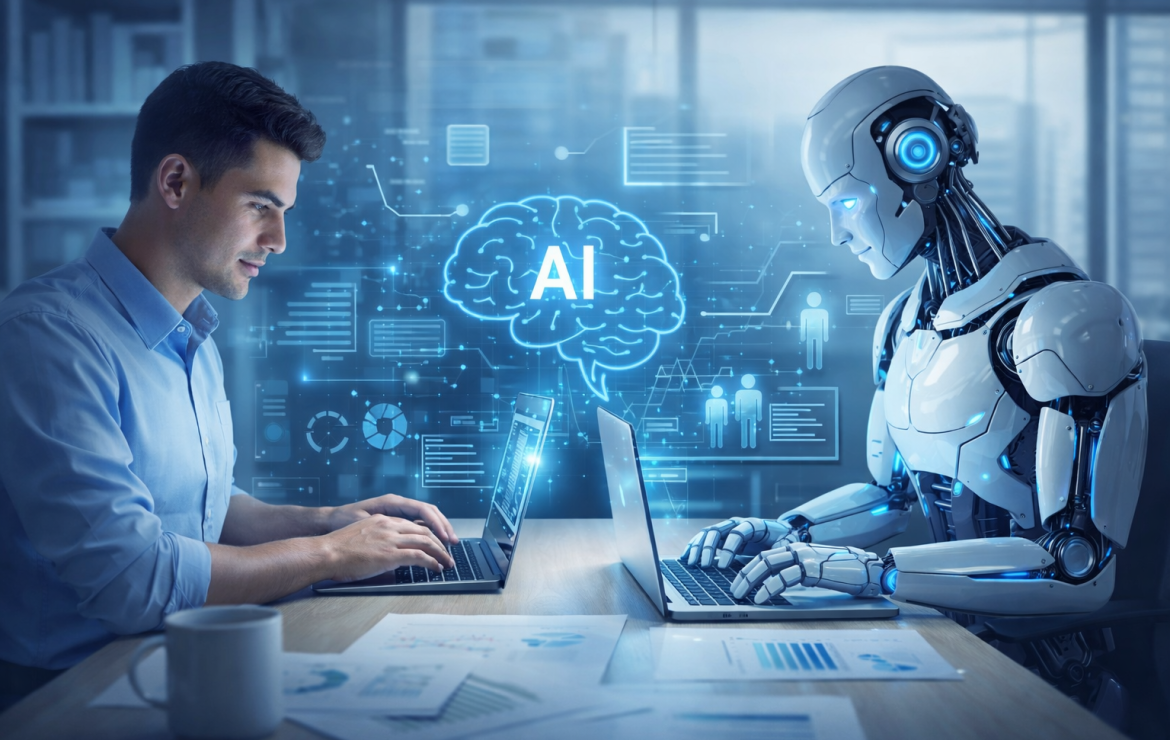
Artificial intelligence is increasingly reshaping how people communicate and think, with experts warning that its widespread use could gradually erode the individuality that defines human expression.
A team of psychologists and computer scientists has cautioned that AI technologies—particularly conversational systems—are weakening the precision of individual differences in speech, writing, and even patterns of thought.
Researchers at University of Southern California suggest that as reliance on AI-powered chatbots grows, it may become more difficult to preserve inherently human traits such as adaptability and logical reasoning. According to their findings, unless this growing “standardisation” is addressed, people’s ability to engage in intuitive and abstract thinking could decline.
The study highlights that large language models—one of the core technologies behind modern AI—have become deeply embedded in everyday life. Drawing on insights from linguistics, psychology, cognitive science, and computer science, the researchers argue that both language and reasoning are increasingly at risk of homogenisation.
They warn that global cognitive diversity may diminish as billions of users rely on a limited number of AI-powered chatbots for an expanding range of tasks. This trend, they suggest, could ultimately lead to reduced creativity and weaker problem-solving abilities.
The researchers also noted that when individuals use chatbots to refine their writing, the output often loses its distinctive stylistic character. According to Zivar Sorati of the University of Southern California, this results in “uniform expressions and ideas across users.”
Beyond language, the team cautioned that the way chatbots generate responses may subtly influence how users think. Individuals may begin adopting the patterns presented to them—patterns that could be based on a relatively narrow and potentially biased subset of human knowledge, depending on the training data used.
Sorati explained that, rather than actively guiding the response-generation process, users often default to the model’s suggestions, selecting answers that appear “good enough” instead of developing their own. Over time, this dynamic may shift initiative away from the user and towards the AI system itself.
To counter these risks, the researchers recommend that developers incorporate greater real-world diversity into the training datasets of machine learning models. Such efforts, they argue, are essential not only to preserving human cognitive diversity but also to enhancing the reasoning capabilities of AI systems.