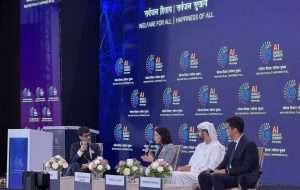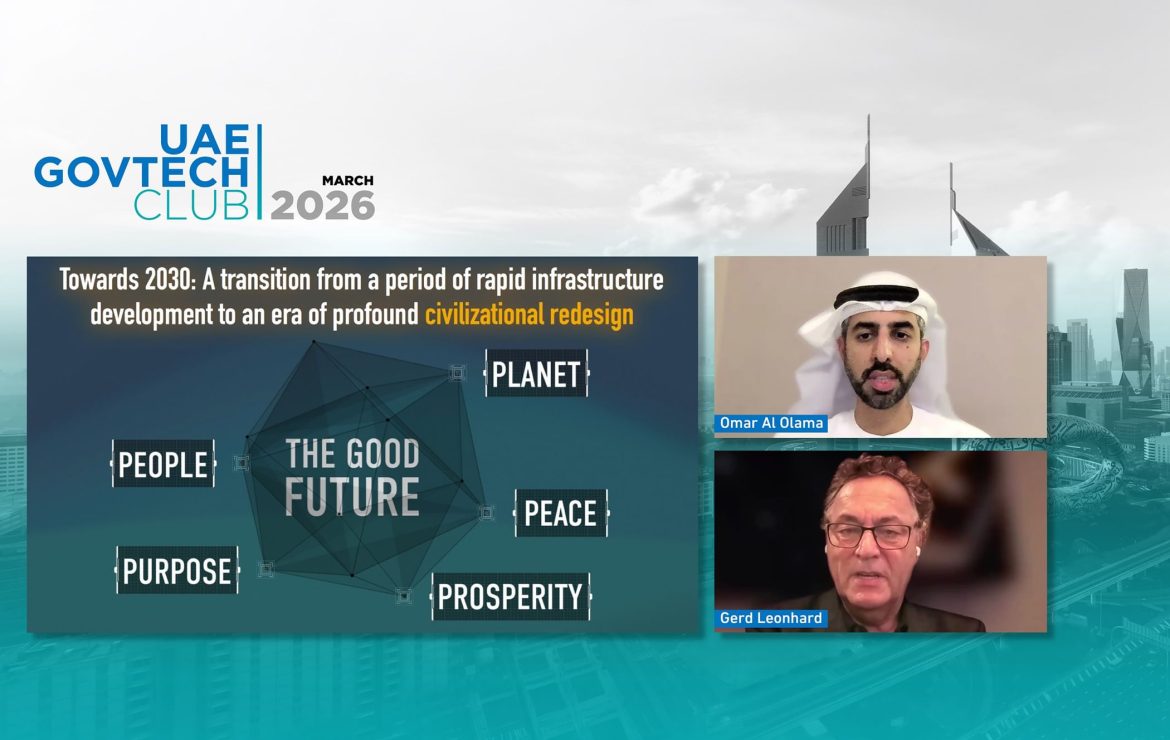
The Government Technology Dialogue has explored the future relationship between humans, artificial intelligence, and advanced technologies over the coming decade, outlining global scenarios as well as the opportunities and challenges shaping governments and societies in the age of AI. Participants emphasised that human and societal prosperity must remain at the core of all government efforts in developing artificial intelligence and emerging technologies.
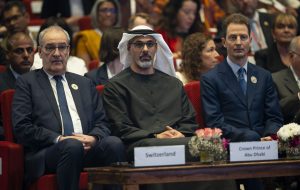
The dialogue, organised by the UAE Government Excellence Programme in collaboration with the Government Knowledge Exchange Office at the Ministry of Cabinet Affairs, brought together ministers and senior officials from more than 15 partner countries involved in the UAE’s knowledge exchange initiatives, alongside UAE ministers and representatives from over 25 federal government entities.
Global Participation and Strategic Vision
The event featured a distinguished group of global experts in government technology, including futurist Gerd Leonhard, who led a session titled “The World by 2030: Technology, Humanity and the Future.” He reviewed the latest technological developments while outlining future opportunities and challenges associated with artificial intelligence.
Omar Sultan Al Olama stressed that the rapid advancement of AI and future technologies requires governments to enhance institutional agility and proactively respond to accelerating transformations. He noted that the UAE leadership recognised early on the pivotal role of AI in shaping future economies and societies, leading to the development of a comprehensive vision that fosters responsible AI innovation, builds national capabilities, and strengthens partnerships with entrepreneurs and leading global technology firms.
For his part, Ahmad Belhoul Al Falasi highlighted that fast-paced developments in AI and advanced technologies are opening new horizons for redesigning government systems, enabling a more proactive approach to future-making. He emphasised the UAE’s integrated approach to deploying advanced technologies across key sectors, including sport, where data and AI are driving both institutional and athletic performance improvements.
Al Falasi added that the Ministry of Sports is working with partners to leverage AI applications in enhancing governance, talent identification, and athlete development through data-driven methodologies, while continuing to invest in human capital to build a more efficient and sustainable sports ecosystem.
Meanwhile, Amna bint Abdullah Al Dahak underscored that AI has become a critical enabler in the UAE’s efforts to achieve sustainable development goals and reach climate neutrality by 2050. She noted that integrating advanced technologies is unlocking unprecedented opportunities across sectors, particularly in modern agriculture, food security, emissions reduction, and biodiversity protection.
Mariam bint Ahmed Al Hammadi praised the initiative, highlighting its role in equipping government leaders with continuous insights into emerging technologies while providing a platform for engagement with global experts in this vital field.
Driving Government Transformation
Mohammed bin Taliah, Assistant Minister of Cabinet Affairs for Government Knowledge Exchange, described the dialogue as a strategic platform supporting the implementation of national priorities and leadership directives. He emphasised its role in empowering government leaders with the knowledge required to keep pace with rapid technological developments and global trends shaping the future.
He added that the initiative serves as a continuous development mechanism aimed at accelerating the adoption of advanced technologies across government entities, enhancing service delivery, improving operational efficiency, and fostering a business-friendly environment while advancing efforts to eliminate bureaucracy through digital transformation.
AI Revolution and the Future of Humanity
During his keynote session, Gerd Leonhard highlighted the UAE’s emergence as a global model in adopting human-centric AI, noting its success in building an innovation-driven framework aligned with future ambitions and global transformations.
He outlined a vision of profound shifts in the relationship between humans and machines, stressing the importance of developing AI models centred on humanity, the planet, and societal prosperity. According to Leonhard, the coming decade could witness transformations exceeding those of an entire century—effectively a “reset” of human civilisation—driven by simultaneous advances in AI, quantum computing, and robotics.
The futurist concluded that the next decade will bring a fundamental civilisational shift powered not only by AI but also by several transformative forces, including supercomputing, humanoid robotics, synthetic biology, nuclear fusion, and genomics. He argued that this transformation requires a new socio-economic framework built around five key pillars: people, planet, purpose, peace, and prosperity—rather than a narrow focus on GDP growth and technological dominance.
Leonhard also emphasised that future-leading societies will not be defined solely by financial resources or computational power, but by their ability to nurture human capabilities such as intuition, imagination, empathy, and emotional intelligence—what he described as “human algorithms”—alongside technological systems.
He concluded by urging nations to develop distinctive and purpose-driven AI identities that prioritise a strong human narrative, ensuring that technology remains a tool for advancing human prosperity rather than becoming an end in itself.
The UAE Government Excellence Programme, launched in 2011, continues to play a central role in elevating public services to world-class standards, focusing on customer satisfaction, service innovation, and the development of a future-oriented government culture.