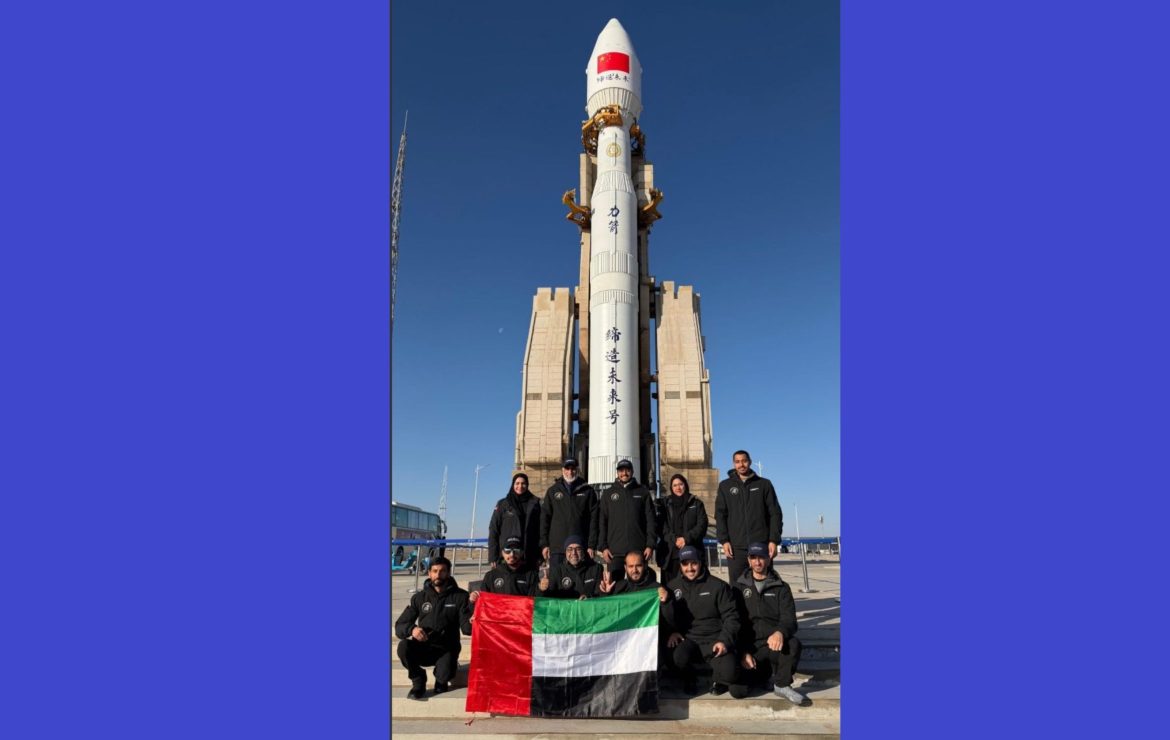
The National Space Science and Technology Center at the United Arab Emirates University has completed all environmental and technical test phases for Arab Satellite 813 at its Assembly, Integration and Testing facility in Al Ain, marking a major milestone in strengthening the UAE’s in-house capability in satellite assembly, testing and operation.
Conducted entirely using national infrastructure and Emirati expertise, the test campaign confirms the Centre’s full readiness to deliver comprehensive qualification activities to international standards, supporting the UAE’s long-term sustainability in the space sector. The satellite has also passed its Launch Readiness Review and Operational Readiness Review, confirming full preparedness for launch and reliable in-orbit operations.
The environmental tests simulated the harsh conditions of launch and space. These included thermal vacuum testing, exposing the satellite to extreme temperature cycles from -173°C to 127°C; vibration testing using 3D axes to evaluate structural resilience; and mass properties testing to ensure precise mass and centre-of-gravity measurements. All tests were executed by specialised Emirati engineers using high-precision equipment in a controlled environment.
The Flight Readiness Review verified that the satellite, launch vehicle and ground systems are fully prepared, while the Operational Readiness Review confirmed the readiness of the ground station and mission operations teams. These milestones follow a complete Assembly, Integration and Testing campaign carried out at NSSTC by certified UAE engineers and technicians under Airbus supervision, marking the first full spacecraft qualification of this scale at the facility.
The Centre noted that the project aims not only to achieve technical success but also to build a sustainable national base of expertise. Comprehensive training programmes with leading partners have enhanced national capabilities in design, assembly and testing, supporting long-term knowledge transfer and the growth of a specialised local industry.
Alongside environmental tests, functional tests for the satellite and its payload were conducted entirely in-house. Locally designed and manufactured mechanical ground support equipment was used, reflecting progress in strengthening an integrated national industrial ecosystem to support the UAE’s space sector.
The successful Flight Readiness Review and Operational Readiness Review also highlight growing national capability in satellite development and operations. After launch, the Al Ain team will lead all mission control activities.
As a flagship initiative under the Arab Space Cooperation Group, Arab Satellite 813 has helped advance knowledge exchange and expand opportunities for Arab engineers and students. The project reflects the UAE’s leadership in promoting regional space cooperation and building sustainable national expertise in space science and technology.
Arab Satellite 813 carries advanced payloads that enable high-resolution hyperspectral imaging to support environmental monitoring and data-driven decision-making in fields such as natural resource management, vegetation monitoring, air and water quality analysis, climate impact assessment and disaster response.
It is the first collaborative satellite project among Arab states, initiated under the directive of His Highness Sheikh Mohammed bin Rashid Al Maktoum, Vice President and Prime Minister of the UAE and Ruler of Dubai, who announced it as a gift to the Arab Space Cooperation Group at the signing of the Arab Space Cooperation Charter.
Developed by the National Space Science and Technology Center in cooperation with member states, the satellite will advance scientific research through environmental mapping, monitoring natural phenomena, analysing land cover dynamics, assessing agricultural crop conditions and tracking water bodies. It will also support studies on land erosion, soil pollution, mining impacts and wider climate-related changes. The mission represents a strategic step towards a sustainable Arab space ecosystem driven by local talent and advanced research.