When a drone lifted off from Noon’s logistics hub in late 2025, carrying a small parcel across Abu Dhabi, it marked one of the UAE’s first airborne autonomous last-mile deliveries. But among the innovations wasn’t just the flight itself, the system orchestrating it from the ground represented a crucial breakthrough in autonomous logistics.
SteerAI’s CoreConnect platform enables autonomous, end-to-end flight while providing real-time monitoring of drone operations, turning what would typically require constant human oversight into a largely autonomous operation. It’s the kind of workflow the region needs as the UAE positions itself as a global hub for advanced air mobility and autonomous systems, where regulatory frameworks, airspace complexity, and operational scale demand purpose-built solutions.
CoreConnect fits perfectly with this environment: multi-jurisdictional airspace, Arabic-English operational requirements, and integration with local infrastructure. It’s a flexible, multi-use platform that handles everything from commercial deliveries to defence operations and high-risk industrial missions across the Emirates.
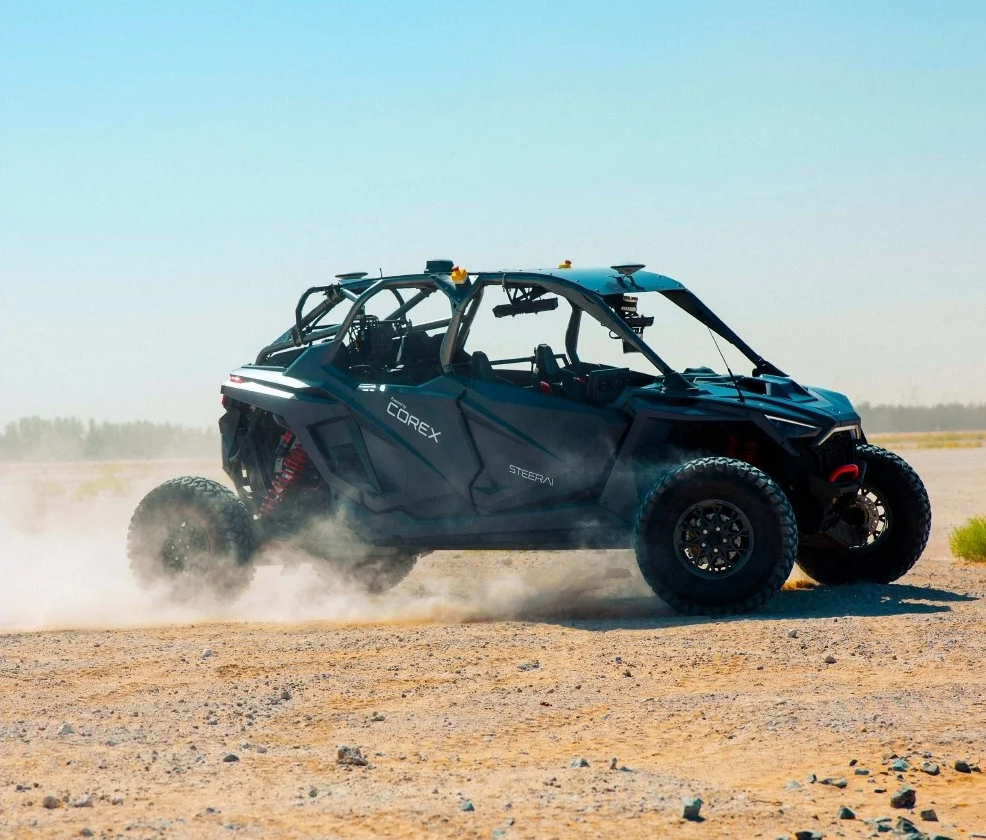
This flight demonstrated CoreConnect’s capabilities in autonomous drone operations. But CoreConnect is just one part of SteerAI’s offer. The company has also developed CoreX, an autonomous system built specifically for the region’s challenging off-road environments, reflecting SteerAI’s broader mission to deliver autonomy solutions tailored to the UAE’s unique operational demands.
“SteerAI was built for the UAE’s most complex environments, especially off-road conditions where traditional systems fail,” said Michael Sonderby, Acting CEO of SteerAI. “As a sovereign company, our goal is to deliver autonomy that actually works here. CoreX and CoreConnect are solving real operational challenges today.”
The technology behind CoreX and CoreConnect was developed by experts at the Technology Innovation Institute (TII), one of the UAE’s leading applied research institutions. In November 2024, VentureOne, which is a dynamic venture builder and commercialises breakthrough research from the Advanced Technology Research Council, launched SteerAI to bring these innovations to market.

Two Sides of the Autonomy Equation
CoreX is the brain of the vehicle, a platform-agnostic autonomous driving software that allows any vehicle or vessel to become autonomous. It consists of several modules that provide perception, localisation, planning, and decision-making capabilities.
CoreX and CoreConnect enable off-road autonomy, improving the safety and efficiency of complex operations. CoreX makes operations more efficient by allowing fewer people to deliver more output. For example, one operator can oversee multiple autonomous vehicles simultaneously, while increasing asset utilisation and improving safety in hazardous, unmapped environments. CoreConnect orchestrates various autonomous vehicles and robots to complete end-to-end autonomous operations. In addition, it provides data-driven insights for efficient operations and optimal fleet utilisation through optimal routing, loading, and asset allocation, meaning one vehicle can generate more productive output in the same amount of time.
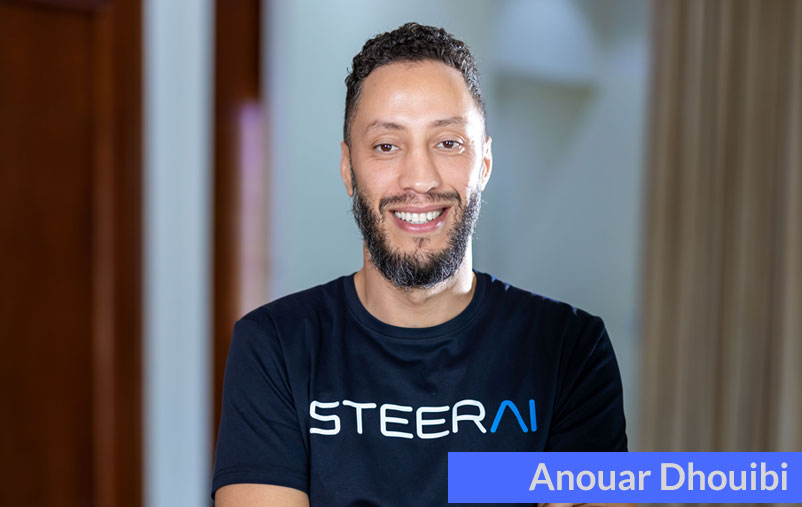
“But very early, we realised you cannot just have a brain,” said Anouar Dhouibi, Executive Director of TII’s Autonomous Robotics Research Centre and Acting CTO at SteerAI, of CoreX.
“You also need a fleet-management system. Once you scale to multiple vehicles, you need something to assign missions, monitor the fleet, understand vehicle status, generate analytics, etc.”
That’s why SteerAI built CoreConnect, a fleet management system that connects to any kind of robot. CoreConnect supervises operations, monitors fleet health, identifies anomalies, enables teleoperation, and gives operators a complete mission picture.
“CoreX and CoreConnect belong together,” Dhouibi said. “They are the two sides of the autonomy equation: intelligent decision-making and intelligent oversight.”
This architecture is what allows SteerAI to operate across very different sectors. In defence, CoreConnect serves as the central command-and-control backbone, facilitating multi-domain autonomous asset integration and high-level mission orchestration. Unlike standard telematics, CoreConnect bridges the gap between raw hardware telemetry and actionable intelligence, enabling commanders to manage heterogeneous fleets of autonomous systems through a single pane.
CoreConnect provides integrated mission management, orchestrating complex, multi-asset manoeuvres that allow for synchronised tasking of ground and aerial units. It moves beyond simple tracking to provide dynamic mission re-planning based on real-time battlefield variables. By synthesising data from CoreX, including battery kinetics, sensor integrity, and AI-detected environmental threats, CoreConnect provides a comprehensive Common Operational Picture. This ensures commanders know not just where an asset is, but its exact combat readiness and “health-to-mission” status.
In contested environments, CoreConnect optimises swarm and fleet orchestration, automating asset distribution and route deconfliction to ensure maximum uptime and efficient throughput in high-tempo operations. Much like its proven success in complex civilian delivery ecosystems such as drone deliveries, CoreConnect facilitates the seamless handshake between autonomous platforms and existing tactical data links, ensuring that autonomous assets are force multipliers rather than isolated silos.
Ensuring CoreX and CoreConnect Sync
Autonomy only works at scale when the intelligence developed by engineers is rigorously integrated and validated for real-world conditions. This is where Thilak Chikmagalore comes in. As a Senior Robotics Integration Engineer at SteerAI, he ensures that CoreX’s robotics solutions, navigation, localisation, perception, and more, are integrated and validated to meet operational requirements.
With experience in embedded systems and robotics in India and Germany, Thilak joined SteerAI specifically to strengthen engineering rigour and validation.
“A big part of my role is bringing engineering practices and structure, so systems are more robust and easier to maintain,” he said. “That way, engineers can focus on solving real problems and building products. I see myself as an enabler.”
Without this type of rigorous integration and validation, many autonomy programs fail when transitioning from lab demos to real operational environments.
From Lab to Market
For Khawla AlMazrouei, a Technical Project Manager at SteerAI, the lab-to-market journey is personal. She began at TII researching perception systems, field-programmable gate array FPGA-accelerated AI, and sensor-fusion algorithms. Only when the Emirati engineer joined SteerAI in the past year and worked on CoreX deployments did she see autonomy differently.
“Research taught me what is possible,” she says. “Deployment taught me what is practical.”
Her work on CoreX’s perception capabilities confronted real-world issues that labs cannot fully simulate, such as sun glare and dust overwhelming sensors, inconsistent terrain, heat affecting cameras, and GPS becoming unreliable.
“These challenges only emerge when steel meets sand,” she said. “When theory meets reality. And that’s where real innovation happens, during testing in the real world.”

Shaping Products with Purpose
Alongside the engineering teams, Janna Katan, a Strategic Product Leader at SteerAI, ensures that the products serve real operational needs and deliver tangible value to customers. She translates user pain points into product requirements and aligns CoreX and CoreConnect features with customer priorities: efficiency, cost reduction, and safety.
“For autonomy to make a real impact, it has to solve the operational problems customers face every day,” she says. “What makes Abu Dhabi unique is that we can turn those needs into products quickly. The vision, support, and execution are all here.”
From last-mile drone deliveries to defence convoys and industrial logistics, CoreX and CoreConnect are already supporting real missions across the country. The technology was engineered in the UAE, but it’s designed to compete internationally, built to handle operational conditions that challenge systems developed elsewhere.

“What we develop today with CoreX and CoreConnect proves that the country can shape its own technological future,” Sonderby said. “And we’re only at the beginning.”